



TL;DR
Your champion has to sell you when you're not in the room. Features don't travel-they scatter and die in translation. Story is the envelope that carries your message intact through the organization. "4 hours to 12 minutes, same team" gets retold. "AI-powered analytics" gets forgotten. Features make you comparable. Story makes you chosen.
Your champion just left your demo. They're excited. They get it. Now they have to explain your solution to Finance, IT, and the CRO. None of whom were in the room.
Without Story: The Feature Dump
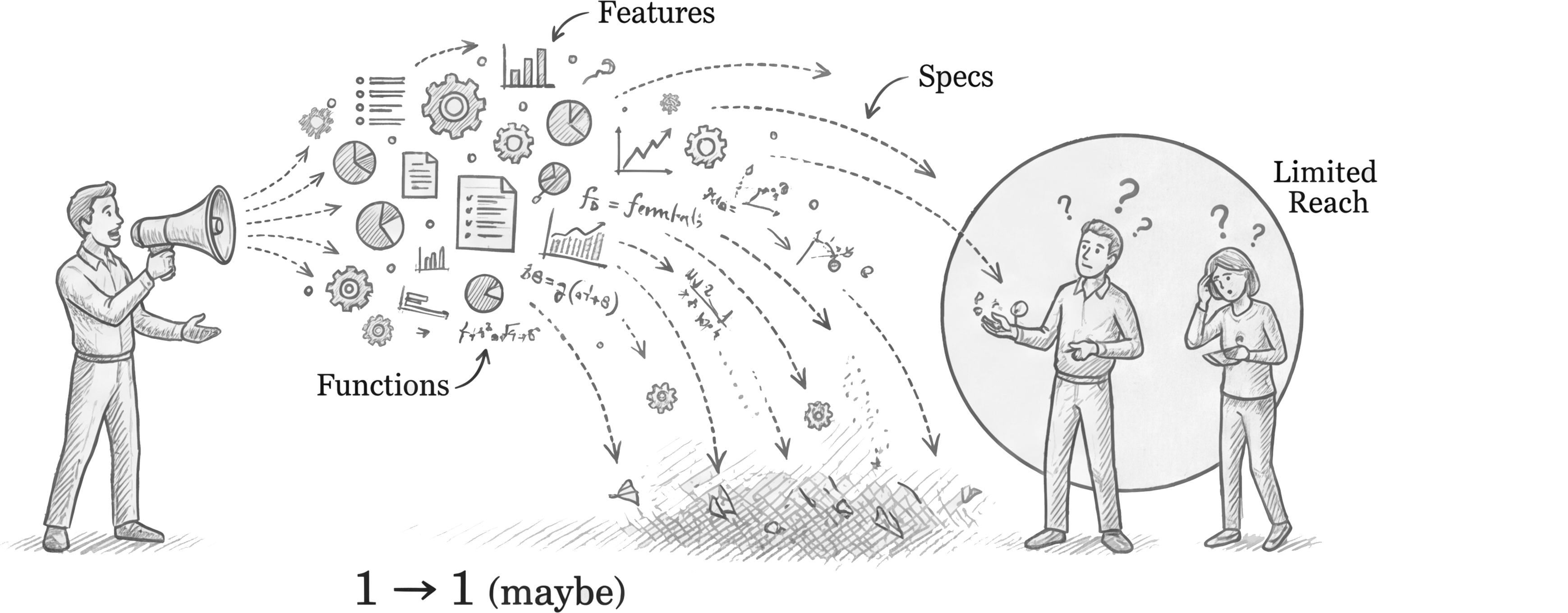
"We have AI-powered analytics with real-time dashboards, configurable workflows, and enterprise-grade security..."
Your champion's voice trails off. The CFO's eyes glaze over. Nobody knows what to do with this information, much less how to retell it.
Result: 1→1 (maybe). The features scatter everywhere but stick nowhere. Your deal stalls in translation.
With Story: The Transformation
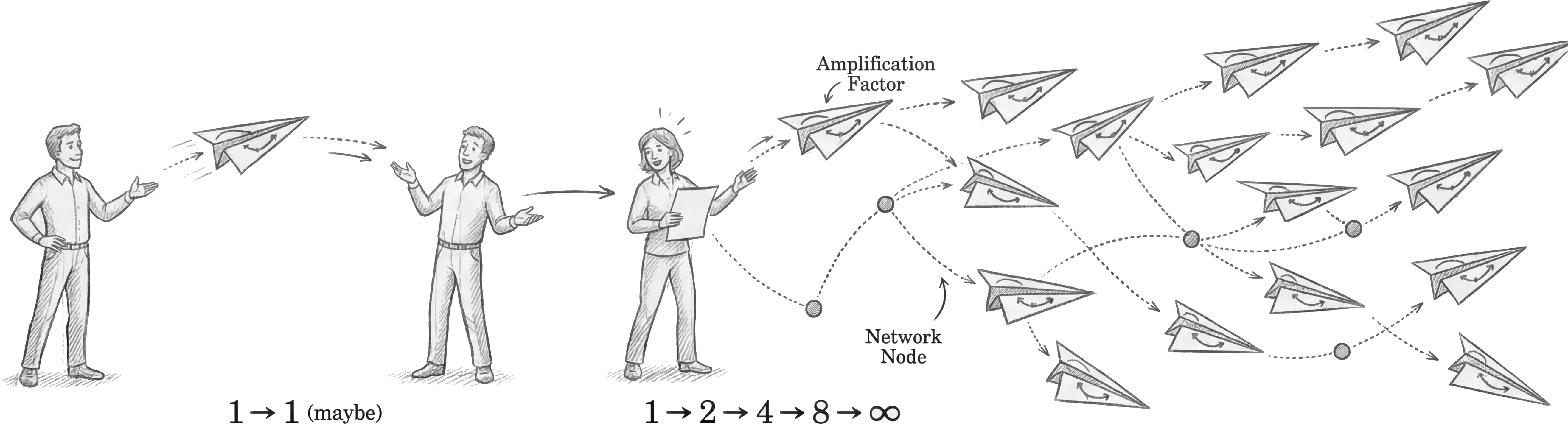
"Our frontline support team was drowning. 4-hour response times. Angry customers. High turnover. Now? 12 minutes. Same team, completely different outcome."
Your champion can retell this. They remember this. More importantly, they can explain it to someone who wasn't in the room without understanding your architecture, your AI model, or your API structure.
Result: 1→2→4→8→∞. Your message travels through the organization, creating amplification you cannot achieve with features alone.
Why Story Works
This isn't sales mythology. It's neuroscience. When Princeton researchers put storytellers and listeners in brain scanners, they discovered why stories outperform feature lists every time.
Here's the science that should change how you sell.

Neural Coupling: Your Brains Sync Up
"When you tell a story, the listener's brain activity mirrors yours. You're literally on the same wavelength."
Princeton researchers found that during storytelling, the listener's brain synchronizes with the storyteller's. They called it 'neural coupling.'
Bullet points don't trigger this. Feature lists don't either. Only stories do.
Your buyer isn't evaluating from the outside. They're inside the story with you, experiencing transformation alongside the characters.
That's why champions retell story-driven demos with passion days later. Their brain simulated living it. AI can present facts. It can't create brain-to-brain sync.
Why This Works: The Neuroscience
Feature lists only activate language processing. Stories light up the visual cortex, motor cortex, and emotion centers.
Stories trigger cortisol (focus), oxytocin (trust), and dopamine (motivation). That cocktail makes your message stick.
Sources: Princeton University neuroimaging study on neural coupling • Zak, P. (2014) on neurochemistry of narrative

The Memory Multiplier: 12x More Memorable
"Stories are remembered dramatically better than facts alone. The data isn't even close."
Stanford study: 63% remembered stories. Only 5% remembered statistics. That's a 12x gap.
Story-based learning achieves 93% long-term recall versus 13% for rote memorization.
A 2024 QJE study found 73% of statistical impact fades within 24 hours. Story-based impact? Only 32% faded.
Tomorrow's meeting: your ROI figures are gone. The story about 4-hour response times dropping to 12 minutes? Still retellable. Still selling for you.
Why This Works: Memory Science
Stories attach data to characters and emotions. They create 'narrative transportation' where attention and emotions align.
Jerome Bruner suggested facts are roughly 20x more likely to be remembered as part of a story. Disconnected facts slip away.
Sources: Heath, C. (Stanford) on story vs. statistics recall • Graeber & Roth (2024) QJE study on story vs. data persistence • Bruner, J. on narrative and memory • Narrative transportation theory research

The Envelope Effect: Stories Travel
"Stories package complex information so people can carry and share it without needing to understand every detail."
Technical details are loose papers. Hand someone fifty, they'll drop most. Put them in an envelope with a clear label? They can carry it anywhere.
Your features and specs are the papers. The story is the envelope.
Without an envelope, features scatter. Technical specs, capability lists, API endpoints. Your champion can't carry them or hand them off.
Story packages truth with context. It travels without degradation. Your champion just needs the envelope.
Why This Works: Cognitive Load
Story frames details within narrative, reducing cognitive load. Facts embedded in stories are easier to recall.
Kendall Haven: well-designed stories are the most effective vehicle for influence. Information alone rarely changes minds.
Sources: Cognitive science on narrative transportation • Haven, K. on business storytelling effectiveness
The Amplification Factor: Retellability Is Everything
"In complex B2B sales, your message must travel through organizations without you. Stories survive that journey. Features don't."
Enterprise deals involve 4+ stakeholders. CFO wants ROI. IT wants low risk. Ops wants smooth change. You won't be in every room.
If your champion only retained 'AI-powered analytics,' they'll stumble. They'll forward your deck.
But '4 hours to 12 minutes, same team'? They can tell that to the CFO in 30 seconds. No technical knowledge required.
The envelope travels intact. Context stays. Your champion hands it off with confidence.
Why This Works: Social Transmission
Emotional engagement creates a brain reward we seek to replicate. Moved buyers share with colleagues.
Emotional contagion propagates your message through the organization, amplifying reach.
Strong specs don't win complex deals. Stories that show fit and reduce risk do.
Sources: Neuroscience of emotional contagion in storytelling • B2B communication research on narrative persuasion • Complex sales research on internal selling
Why This Matters Now
Modern buyers complete 70%+ of research before engaging. They use ChatGPT to build shortlists. They show up having compared you to three competitors, read your docs, and built evaluation scorecards.
They don't need you to recite features. They already found those.
What they can't get from AI or your website is understanding what success looks like in their world. And how to explain it to their boss.
Story creates a bridge from what they already care about (not getting fired, hitting bonus metrics, reducing stress) to your technical capabilities.
'4 hours to 12 minutes' isn't just a metric. It's a picture of a team going home on time. A manager getting fewer escalations. A business keeping customers. That's what they can repeat to others.
The envelope carries the features, but frames them with meaning.
The Practical Truth: Your Champion Is Your Channel
Most deals aren't decided in rooms where you're presenting. Your champion returns to their desk and must re-explain you to people who weren't there, don't share context, and may not care about technology.
If all they retained is loose features, they stumble. If they retained an envelope, they retell it with high fidelity. Because the point wasn't the individual parts inside. It was the transformation the envelope represented.
You're not just selling to one person. You're equipping that person to sell for you when you're not in the room.
Story is how you do that. Features scatter. Envelopes travel. And in B2B sales, the message that travels wins. Stories are your envelope. But what about the data inside? The next chapter shows you how to weave metrics into story without breaking the spell.
References
Behavioral science research supporting this chapter